What Trimming Fixes
| What's going on | What usually fixes it |
|---|---|
| Limbs on the roof or in the gutters | Reducing or removing the limbs that reach the house, cut back to a side branch |
| City clearance notice, low limbs over the sidewalk or street | Crown raising: removing lower limbs to lift the canopy |
| Dead branches dropping after every storm | Deadwood removal throughout the crown |
| Heavy, crowded canopy that catches wind | Thinning selected limbs so wind passes through |
| Mistletoe clumps in cedar elm or hackberry | Pruning out infested branches, usually in winter |
| Thick gray ball moss on inside oak branches | Thinning the interior; the moss itself doesn't harm the tree |
| A trunk splitting into two equal stems | Cabling or bracing, if the tree is worth keeping |
| Palm fronds browning and hanging | Removing dead fronds and seed stalks |
The City Clearance Rule
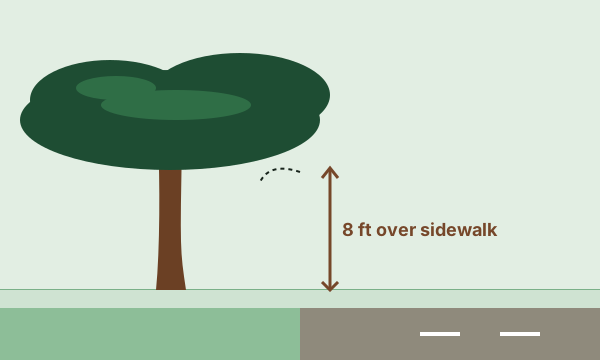
San Marcos asks property owners to keep trees and shrubs clear of streets and sidewalks. The city's guidance is at least 8 feet of clearance over the strip between the property line and the curb, and 16 feet at the center of the street. If an inspector hangs a notice on the door, you have 10 days to take care of it.
On a mature live oak, that usually means raising the canopy by removing the lowest limbs over the curb and street. Done right, the tree keeps its shape. Done badly, it ends up with a tall, bare trunk and all its weight at the ends of the limbs.
Timing by Species
| Tree | Best window | Why |
|---|---|---|
| Live oak, Texas red oak, post oak, shumard oak | July through January, coldest months preferred | Avoids the February 1 through June 30 oak wilt risk period. Every cut painted. |
| Cedar elm, hackberry | Late winter | Mistletoe is easy to see once leaves drop |
| Pecan | Late winter, before buds break | Structure is easy to read without leaves |
| Ashe juniper | Any time | No oak wilt concern |
| Bald cypress | Late fall through winter | Dormant season, less stress |
| Palms | Late spring or summer | Leave green fronds through winter for cold protection |
Storm damage gets fixed when it happens, whatever the month. A broken oak limb is cut clean and painted right away.
Want oak trimming in the safe window?
Call (877) 674-2213Please stay on the line while your call connects.More detail: When to trim oak trees in Hays County and the oak care page.
Cuts That Hurt Trees
Topping. Cutting the top back to stubs. The tree answers with a mass of weakly attached sprouts and decay starts in every stub. A topped tree is more dangerous a few years later, not less.
Lion-tailing. Stripping all the inner branches and leaving tufts at the ends. It shifts weight outward and makes limbs more likely to snap in wind.
Flush cuts. Cutting tight against the trunk instead of just outside the branch collar, the slightly swollen ring where the branch meets the trunk. The tree can't seal a flush cut well.
Removing too much at once. Taking more than about a quarter of a healthy tree's leaves in one season stresses it, especially going into a Texas summer.
Mistletoe and Ball Moss
These two get confused. Mistletoe is the green, leafy clump with small white berries, rooted into the branch and drawing water from it. It's most common in cedar elm and hackberry around here and shows up clearly in winter. Ball moss is the gray, wiry tuft on oaks. It gets its water from the air and doesn't feed on the tree. Mistletoe needs pruning out; ball moss usually just needs a thinner, sunnier canopy. Mistletoe in cedar elms and hackberries
Cabling and Bracing
A tree with two big stems joined in a tight V, or a long heavy limb over a roof, can sometimes be kept with a steel cable or a brace rod installed high in the crown. It limits how far the stems can move in wind. It isn't a cure for decay. If the trunk is hollow or cracked to the base, removal is the honest answer.
Branches Over the Property Line
Under Texas law, you can generally trim a neighbor's branches back to your property line, as long as you don't go onto their property or seriously harm the tree. Talk to the neighbor first; often they'll split the job. This is general information, not legal advice. Neighbor tree questions
Trimming Questions
How often should trees be trimmed?
Young trees benefit from light structural pruning every couple of years. Mature shade trees usually need attention every three to five years, or after a major storm.
Will trimming fix a leaning tree?
Reducing weight on the leaning side can help a little. A tree leaning because its roots are failing needs to be looked at for removal.
Can the crew trim near power lines?
Lines running from the pole to the house are often handled by a tree crew with care. Main lines along the street belong to the electric provider, so call them for those.